I was walking around London past the usual stretch of luxury stores – and the windows were exactly as you would expect; the displays all immaculate, controlled, and instantly recognisable. Nothing seems to have changed on the surface, but something has shifted in what those brands now represent.
Because the reality is, most of what you see in those windows is no longer out of reach in the way it once was. You can find it through luxury resale platforms such as Vestiaire Collective, you can rent it for a weekend through platforms such as By Rotation , HURR or MY WARDROBE HQ , and you can access it without ever stepping into the brand’s world in-store.
When Access Changes, Meaning Changes With It
The barrier that once defined luxury was access, and that has quietly dissolved. When access changes, meaning changes with it.
A decade ago, I was having very different conversations about fashion. Sustainable luxury felt like a clear direction: buy less, choose well, invest in premium quality, build a wardrobe that lasts. There was a sense that if you made the right decisions, you could arrive somewhere stable, something resolved, a wardrobe that reflected who you were and held its relevance over time. I believed that, and I built my work around that way of thinking.
Now, it feels incomplete. Not because those principles are wrong, but because the context has changed so significantly that they no longer tell the full story.
The Issue Is No Longer Access. It Is Volume.
The scale of the industry alone has reshaped everything. We are producing over 100 billion garments a year, and at the same time the resale market has expanded at pace. What was once a niche behaviour is now embedded. Resale platforms such as Vestiaire Collective have helped normalise pre-owned designer fashion, while broader re-commerce platforms such as Vinted show just how quickly secondhand shopping has scaled.
On paper, that looks like progress, and in many ways it is. Pieces are being recirculated, wardrobes are more flexible, and the idea that clothing has a longer life cycle is now widely accepted. But not all clothes and accessories are created equal, or designed for longterm use.
But what I see in practice is something more complicated. The issue is no longer access. It is volume. There is more product, more choice, and more availability than ever before, and that has created a different kind of friction.
The Issue Is No Longer Access. It Is Volume.
Charity shops are overwhelmed, vintage no longer guarantees quality, and “pre-loved” has become a broad category that doesn’t distinguish between something that holds value and something that simply hasn’t yet been discarded. Not everything that circulates still deserves a place in the luxury conversation, and that distinction is becoming increasingly important.
From Ownership to Access
At the same time, rental has changed how people experience luxury altogether. Platforms such as By Rotation, HURR and MY WARDROBE HQ have shifted the model from ownership to access. You can wear something exceptional without committing to it, which opens up a level of experimentation that wasn’t previously available. That flexibility is powerful, but it also adds another layer of complexity.
The New Luxury Question: Does This Actually Align With Me?
If you can access almost anything, the question is no longer “can I have this?” but “does this actually align with me?”
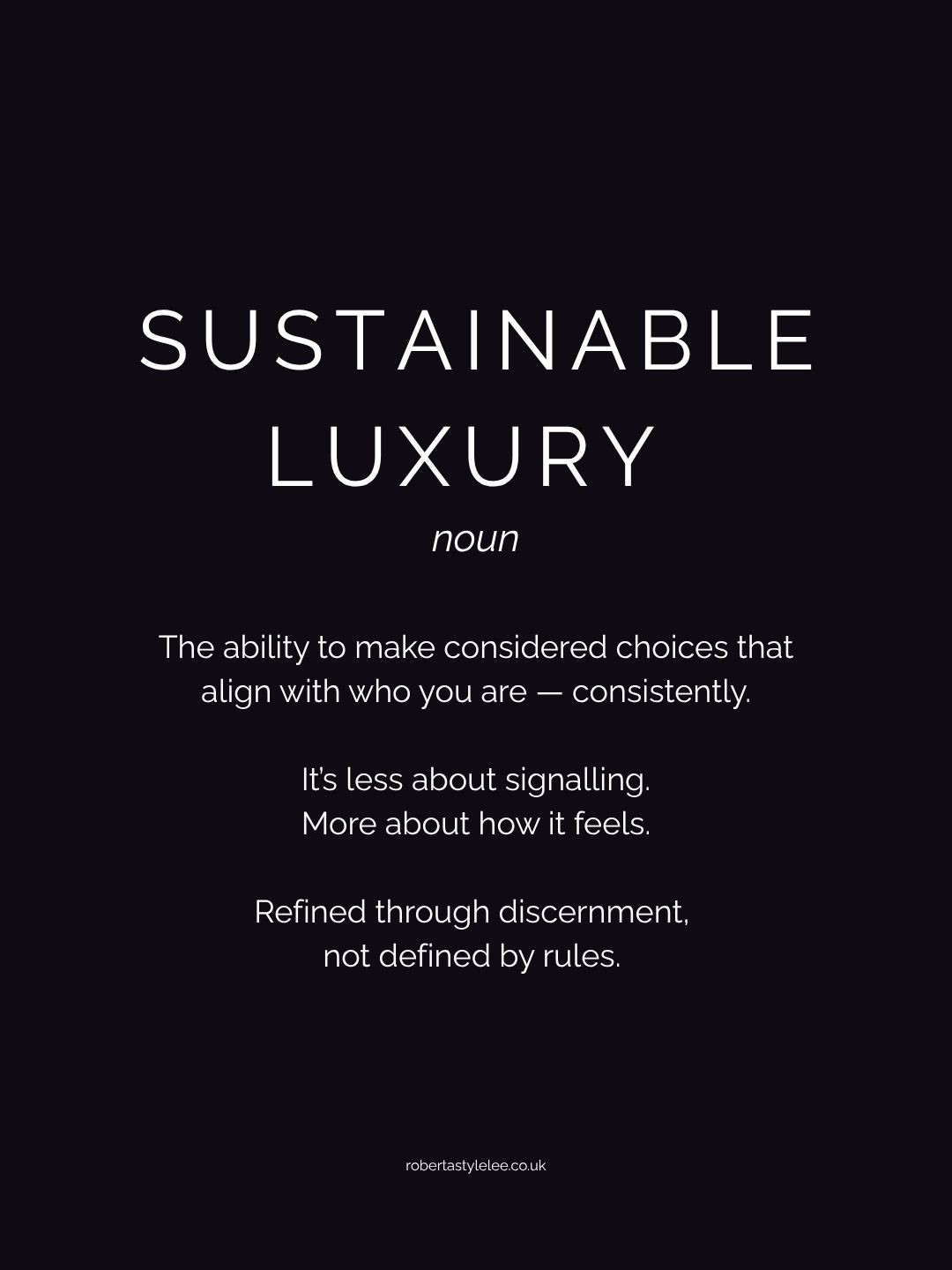
This is where the conversation around sustainable luxury starts to mature. It is no longer just about the product or the purchase itself. It is about everything that surrounds it: the decision to buy, the context you are buying for, how that piece integrates into your life, whether you return to it, and what happens when it no longer reflects who you are. Luxury used to be defined by the moments leading up to acquisition. Now, it is defined by the entire lifecycle and how you engage with what you wear.
Why Sustainable Luxury Has Become More Complex
What’s interesting is that while consumers are engaging with luxury more fluidly through resale and rental, brands are having to become far more intentional about how they control positioning, distribution, and narrative in order to maintain value.
The Women I Work With Are Not Lacking Access
This is also where I see the greatest tension in my work. The women I work with are not lacking access or awareness. They are thoughtful, informed, and increasingly intentional. They are buying better, exploring resale, and experimenting with rental. On paper, they are doing everything “right,” and yet there is often a disconnect. Not because they lack taste, but because no one has shown them how to bring all of those decisions together in a way that feels coherent.
The Myth of the Finished Wardrobe
Ten years ago, I would have said that the goal was to build a single, well-considered wardrobe that could carry you through different stages of life. Now, I see that idea as overly fixed. We do not stay the same. Our lives evolve, our environments change, and our sense of identity shifts, sometimes subtly, sometimes significantly. A wardrobe that once felt aligned can become restrictive if it is tied too closely to a previous version of you.
There is no such thing as a finished wardrobe, only an ongoing process of refinement. Building a sustainable wardrobe is a journey, not a final destination.
From Exploration to Refinement
If I was writing this in my twenties, I would have approached it very differently. I would have been completely on board with the variety, the access, the opportunity to explore. At that stage, I was still getting to know myself. I couldn’t have defined a signature style because I was still expanding, learning, and enjoying the range of options available to me. And we are, as women, spoilt for choice. I never wanted to limit that. But what I’ve come to understand over time is that as we move through the decades that follow, that sense of knowing ourselves becomes much deeper.
The decisions become less about exploration and more about refinement. Things that once felt absolute in my twenties shifted in my thirties, and even now, in my forties, I can see how my perspective continues to evolve. That’s the reality of it. Which is why trying to fix your wardrobe, or your style, at any one point in time rarely holds.
Why Discernment Matters More Than Access
This is where discernment becomes far more important than access. Money can buy access to luxury, but it cannot teach you how to choose.
That distinction has always existed, but it is far more visible now. We have all seen wardrobes that represent significant financial investment but lack coherence. Multiple brands, recognisable pieces, strong individual items, but no clear point of view – a walking billboard for brands and their logos. What those wardrobes communicate is not style, but purchasing power, and those are not the same thing.
Why Hermès Still Holds Cultural Power
Traditional luxury has always operated differently. A Hermès Birkin bag does not rely on overt branding to communicate its value. It is understood through craftsmanship, context, and cultural knowledge, but also through the very controlled way in which it is released. Access isn’t immediate or guaranteed, and that level of control is part of what sustains its value.
However, even Hermès cannot control what happens after… because you can rent a Birkin from various rental platforms now.
Yet you still recognise it because you understand what it represents, not because it announces itself. That is the space luxury is moving towards more broadly. Less about performance, more about alignment and recognition.
Luxury Is Moving Towards Alignment
We are living through a moment where the definition of luxury is evolving. Ownership, access, identity, and belonging are no longer fixed in the way they once were. That creates opportunity, but it also creates confusion.
Without a clear sense of self, it becomes very easy to use fashion as a way of trying on identities that do not quite fit, attaching yourself to brands or aesthetics that feel close, but not quite right.
Why Strategy Matters More Than Ever
This is why strategy matters more than ever. Not in a rigid sense, but in a reflective one.
Understanding where you are, what you need, what no longer fits, and what you are moving towards. Luxury has not disappeared, but it has shifted away from access and towards alignment.
And the women who navigate that shift well are not the ones buying the most, but the ones who understand how everything they choose — before, during, and after purchase — connects back to who they are becoming.
If you’re at a point where your wardrobe no longer reflects who you are now, this is exactly the work I do with clients.
You can start with a Style Synopsis, or request a Private Consultation to explore what this could look like for you.